
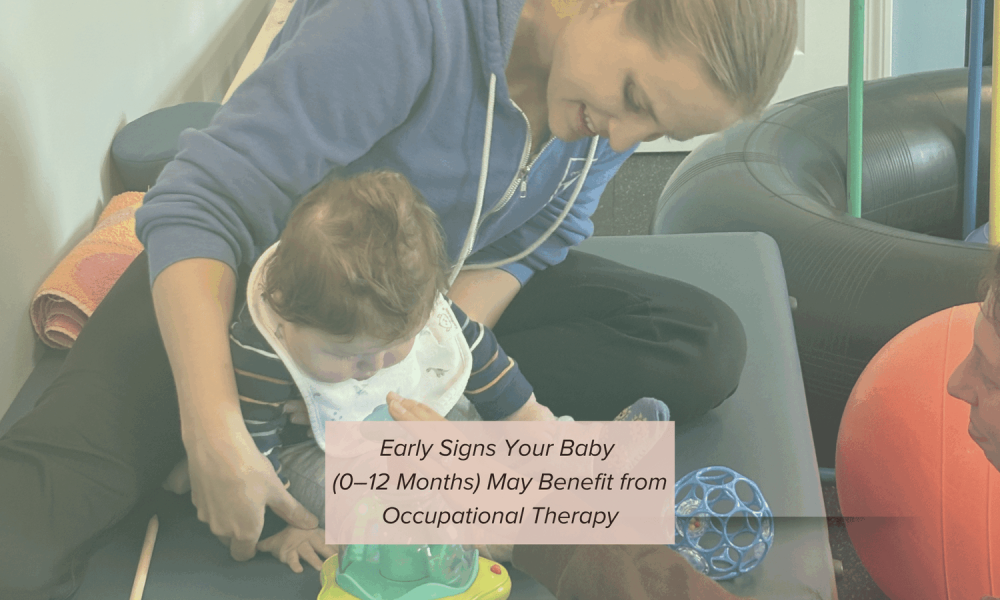
Early Signs Your Baby (0–12 Months) May Benefit from Occupational Therapy
The first year of life is full of rapid growth. Babies are learning how to move their bodies, explore their environment, and interact with the people around them. While every child develops at their own pace, there are general patterns we expect to see as skills begin to emerge.
Sometimes, differences in movement or play can be early indicators that additional support may be helpful. Occupational therapy (OT) focuses on helping babies build the foundational skills needed for movement, play, and daily routines.
Amanda Quigley, Occupational Therapist, OTR/L, shares early signs to look for that may indicate your child could benefit from occupational therapy.
Below are some early signs to look out for in the first year, and how OT can help.
Motor Development
Motor development supports how babies move, explore, and engage with their environment. Early movement experiences help build strength, coordination, and control needed for later skills.
Poor Tolerance of Tummy Time (Any Age)
Tummy time supports development of strength in the neck, shoulders, and core, which are important for later skills like rolling and sitting. While some babies need time to adjust, consistent difficulty may be worth noting.
Red flags:
- Cries almost immediately when placed on their stomach
- Only tolerates for a few seconds
- Keeps head turned to 1 side or does not lift head
- Stiffens or arches back
- Becomes easily overwhelmed and difficult to calm afterward
You may also notice that tummy time is difficult to incorporate into daily routines due to distress or limited tolerance.
Reduced Hands to Mouth and Hands to Midline (2–4 Months)
Bringing hands to the mouth and together at midline is an early developmental skill that supports coordination and body awareness.
Red flags:
- Rarely brings hands to mouth (2–3 months)
- Limited ability to bring both hands together at midline (3–4 months)
- Keeps arms stiff, extended, or tucked back rather than moving freely
- Prefers only 1 hand or shows little spontaneous reaching
- Minimal exploration of hands, toys, or caregiver’s body
These early movements support later skills such as reaching, grasping, and interacting with objects.
Delayed or Atypical Crawling Patterns (8–10 Months)
As babies grow, they begin to move toward objects and people in their environment. Crawling is one way babies develop strength and coordination, though variations in how babies move can occur.
Red flags:
- Not attempting to crawl or move toward toys by 8–10 months
- Prefers butt scooting, hitch crawling, or pulling with arms only
- Limited weight bearing on hands and knees
- Difficulty getting into or maintaining a hands and knees position
- Uses 1 side of the body more than the other when moving
- Avoids floor time or becomes upset when placed on hands and knees
You may also notice frustration with movement or avoidance of positions that require weight bearing or coordination.
What This Might Suggest
These signs do not necessarily indicate a specific diagnosis, but they can point to areas where a baby may benefit from support:
- Decreased strength (neck, shoulders, core, upper body) or decreased motor control, decreased coordination
- Limited postural control needed for future skills like rolling and sitting
- Sensory processing differences such as discomfort with movement or position changes or avoiding weight bearing through hands
- Possible tightness such as a preference for 1 side
- Reduced opportunities for movement or floor time related to positioning
- Difficulty with later skills such as reaching, grasping, and self-feeding
Often, these areas are connected and can influence one another as development progresses.
How Occupational Therapy Can Help
Occupational therapy uses play-based strategies to support development while also guiding caregivers on how to carry over strategies into daily routines.
- Modify positioning
- Graded exposure
- Incorporate sensory supports
- Address underlying strength, coordination, tone, postural control or asymmetry concerns and movement patterns
- Facilitate midline orientation and bilateral coordination
- Support hands-to-mouth play and early self-soothing skills
- Provide caregiver strategies to increase active hand use during daily routines
- Facilitate hands and knees positioning and transitions
- Build core, shoulder, and hand strength through play
- Provide strategies to increase tolerance
- Guide caregivers on positioning and play routines to support development
OT focuses on making these skills easier to practice throughout everyday activities, not just during sessions.
How to Take the Next Step
If you recognize some of these signs in your child, it is a good idea to start by talking with your pediatrician. They can help determine if what you are seeing is part of your child’s development or if additional support may be helpful.
Your pediatrician can also provide a referral for an occupational therapy evaluation if needed. This evaluation can take a closer look at your child’s motor skills, sensory processing, and overall development, along with guidance on next steps.
Early support can make a meaningful difference and help you feel more confident in how to support your child at home.
At Cheshire Fitness Zone, our team is here to support your family. If you have questions or would like to learn more about occupational therapy services, reach out to us anytime.

Meet Amanda Quigley, OTR/L
Amanda attended Springfield College and has been practicing since 2016. She is an occupational therapist who supports children with developmental delays and neurological differences. She is especially interested in working with children with neurological differences to help establish functional motor patterns and also enjoys supporting sensory processing development and providing feeding therapy services for picky eaters and children transitioning to solid foods. Amanda has completed NDT training and additional training in various feeding therapy approaches. She enjoys working with and supporting the entire family and currently serves as the Guilford site supervisor and site lead. Outside of work, she enjoys spending time outdoors with her son, daughter, and their boxer, Jameson, as well as reading, crafting, and baking.